
Roderick Glerum (Vattenfall): ‘Don't wait to invest in the energy transition’
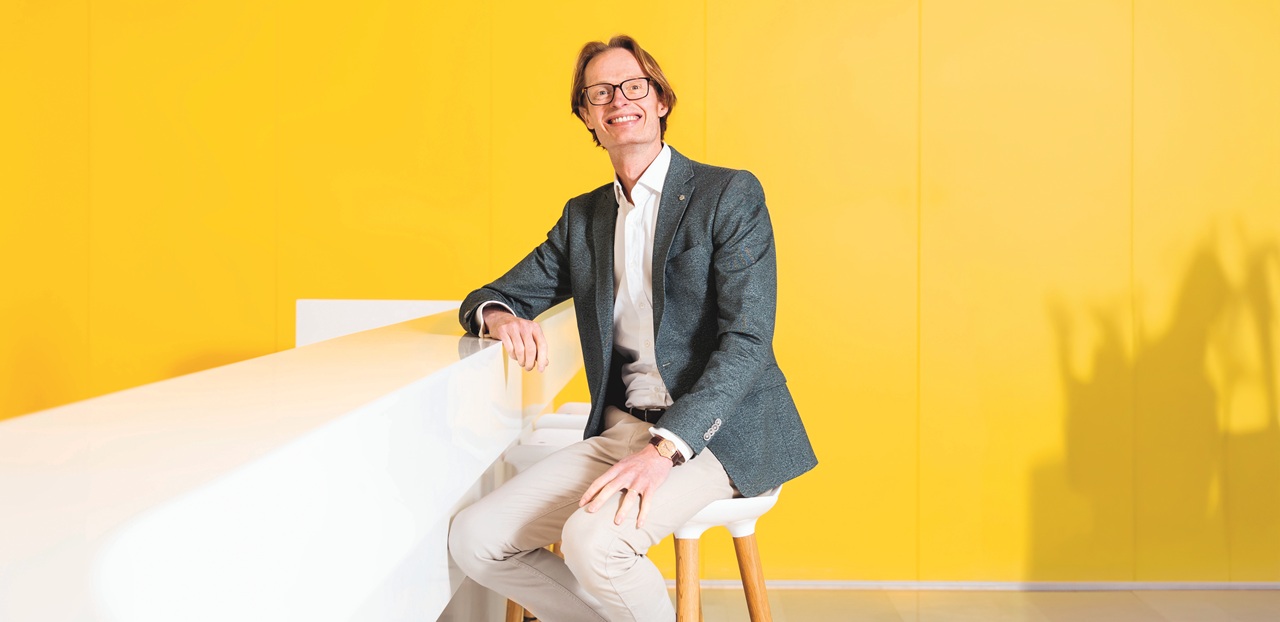
Visitors to the Dutch headquarters of energy company Vattenfall, a stone's throw from the Amsterdam Bijlmer Arena train and metro station, get handed a reusable cup at reception, with a request to deposit it in the recycling bin next to the exit when leaving. This is in line with Vattenfall's commitment to implementing sustainability throughout the company and thereby setting a good example for customers. All major commercial energy consumers in the Netherlands – mainly greenhouse horticulture, industry, data centers, transport and storage, and the real estate sector – who are customers of Vattenfall, fall under the responsibility of Business Market Director Roderick Glerum. ‘I see it as my and my team's mission to work with our business customers to significantly reduce CO2 emissions from production processes, lighting, and heating in commercial buildings.’
Vattenfall has committed to the Science Based Targets initiative (SBTi) and aims to achieve net-zero emissions across its entire value chain by 2040. ‘We take this very seriously and are trying to move in the same direction with our business customers. We do however see achieving the interim targets for 2030 as challenging. The energy transition in the Netherlands is currently progressing more slowly than we had hoped. There are delays, which occasionally leads to difficult discussions with customers. We share the same ambition, although we do not always agree on the speed at which it can and should happen. Sometimes we would like to see customers move faster, but conversely, there are also cases where a party is ready to move very quickly and the business case is sound, but it is simply not possible due to grid congestion. On that specifically, we cannot make a difference. The fact that we run into the same obstacles, also creates a sense of solidarity: we are in this together.’
You have been working at Nuon/Vattenfall since 2007, mainly in sales positions. How has the relationship with customers changed during that time?
‘In the past, discussions often focused on multi-year contracts, preferably at a fixed price, without many bells and whistles and with complete flexibility in purchasing. These were negotiations where you were more or less on opposite sides. That classic dichotomy between producer and customer no longer exists, because ultimately, everyone has become a producer. These days, we work with customers to examine the energy challenges at hand, what the social costs are, how we can make it more sustainable, and what type of contract and purchasing strategy is appropriate. Because the market is so uncertain, prices have also become very volatile. That is why we have become more cautious about long-term contracts. We now tend to make framework agreements for one or two years and, within that framework, we monitor market dynamics on an almost daily basis and determine whether purchase volumes need to be adjusted upwards or downwards.’
You mentioned customers' willingness to become more sustainable. How does this manifest itself in practice?
‘The phase where we had to encourage customers to green their electricity consumption is well behind us. It matters where the electricity comes from: that awareness is there. Moreover, more and more parties are implementing energy management systems to gain insight into what they themselves can do to absorb peaks, achieve reductions, or use energy-intensive equipment differently. After all, to measure is to know.
The big step that still needs to be taken is to reduce gas consumption through electrification, because that is still the primary source of CO2 emissions. This proves to be a particularly big challenge in industrial high-temperature processes. Technically, it is the most difficult to replace gas in these processes, and on top of that we have insufficient green gas to replace gray gas. Hydrogen is a promising option, but for the time being it is not commercially viable. Electrification using heat pumps and e-boilers, among other things, is part of the solution, but even then, you often need a gas boiler as backup. Reduction is possible, but for the time being, zero emission in industry is not yet feasible. We must accept this if we want to preserve jobs. Moreover, it is no solution to the CO₂ problem if those companies leave the Netherlands and continue to produce, in the same way, elsewhere in the EU or even beyond.’
What role does grid congestion play in companies' investment decisions?
‘It makes planning difficult, and not only for the industry that wants to transition from gas to electricity. There are real estate companies, for example, that want to open new, sustainable buildings but cannot connect to the grid at a planned location. This last point, incidentally, is primarily a problem of the old world, where the inside-out approach was used, whereby the location of a building was decided first, and the availability of a connection was not considered upfront in that decision. I see that changing now. Parties now considering new locations are considering the energy issue upfront, although this remains difficult because it is not always possible to know in advance where grid congestion will occur and where you need to take your place in the waiting line.
An increasing number of companies are therefore thinking, very creatively and innovatively, about how they can use energy even more efficiently and cleverly at their current location, to minimize their connection capacity. For example, batteries can help maximize on-site use of self-generated sustainable energy. Is it a business case that always pays for itself very quickly? That varies from customer to customer and can sometimes be disappointing, but we are beginning to see that it often does pay off handsomely.
Another trend is to collaborate on solutions, for example at the business park level. If one company needs electricity mainly at night and another during the day, they can eliminate peaks by sharing a network connection. I sometimes compare grid congestion to being stuck in traffic. Both are incredibly frustrating, but eventually, we always find detours to get to our planned destination. And sometimes we end up in a completely different, more beautiful destination.’
Apart from grid congestion, what makes the energy transition so challenging?
‘The situation now is extremely complex anyway, as practically everything is changing. The way we generate, consume, and store energy. There are geopolitical hotspots around the world, including in areas where the raw materials we need for the transition come from. And then there is a market that reacts with hypersensitivity to every phone call between Putin and Trump, although I think we have thankfully become somewhat desensitized to that by now. All these developments contribute to market volatility. To mitigate this, we should not blindly focus on a single technology with a single type of raw material from a single region. We need more strategic autonomy and a broad range of different solutions.’
According to TenneT's Supply Security Monitor 2024, the reliability and security of electricity supply in the Netherlands will come under pressure after 2030, partly due to the growth of renewable energy and increasing demand for electricity. What needs to be done to prevent the transition to a more sustainable energy system from shooting itself in the foot?
‘First of all, there needs to be a stable long-term vision - preferably at European level - on how we can maintain the security of supply and affordability of the energy system. In the Netherlands specifically, research is currently underway to determine whether it is necessary to transition from the current ‘energy-only’ market - in which producers are paid only for the energy they supply - to a capacity mechanism. This means that producers would not only be paid for the energy they supply, but also for the fact that they have certain capacity on standby. Think, for example, of gas-fired power plants, but also of batteries and other technologies that can be scaled up when the wind is not blowing and the sun is not shining, periods that are so aptly described as Dunkelflaute in German. At present, keeping gas-fired power plants open is hardly profitable because, thanks to the increase in renewable energy, they are idle most of the time. But you want to be able to rely on these power plants when security of supply is at stake. The first drafts on how to set up such a capacity mechanism are already on paper.’
What else can the government do to accelerate the energy transition?
‘Perhaps the most underestimated aspect of our work is the enormous effort required to translate new (European) government policy into everyday practice. A good example is the new Energy Act, which will come into force in 2026. It distinguishes between large consumers and micro-enterprises, with the latter group receiving more protection compared to that afforded to consumers. I understand that you want to provide smaller parties a certain degree of protection. However, it has a huge impact on daily practice and requires a multitude of adjustments to the systems. The question is whether this always leads to the best solutions for our customers. In any case, you cannot invest the time and resources required for implementation, in devising solutions to reduce CO₂ emissions for these types of parties. My concern is that, with the best intentions, we discuss so many ideas that the things that can really make a difference get buried or, at the very least, significantly delayed.
My message is that, for every solution and change the government wants to implement, we must continue to assess how it will best contribute to solving our most significant problems. In doing so, remaining in dialogue with market participants before, during, and after implementation is always desirable.’
What can companies themselves do better regarding the energy transition?
‘Most important, do not postpone sustainable investments until there is a new government with a clear vision, or all the regulations for the next ten years have been formalized. There will always be another government or another law of which you cannot foresee all the details. Then you will just keep waiting.
The only way to move forward is to experiment and try things out. Start small on one location, see if it works, and then roll it out. Or do not roll it out if it does not work or is not profitable. It can be incredibly frustrating when you hit a wall or have to take three steps back, but that complexity and overarching chaos also stimulate creativity. In that respect, I am optimistic about the future.’
Indeed? I increasingly hear people around me saying that our sustainability efforts are pointless because climate damage caused by wars and wildfires, for example, negates them.
‘If you look at the broader global context from the small Netherlands, you can indeed sometimes feel discouraged. Yet, I think we should keep our focus small and close to home for now. If we lead by example, it will ultimately contribute hugely to overcoming these challenges. If we have learned one thing from the past, it is that we are innovative and creative enough to find a solution to every problem. To draw another analogy... Before bamboo emerges above ground, its root system has been expanding underground for years. Once it emerges, it can grow almost a meter per day. That is how I view the energy transition. We have been working for years to expand the roots and network, but they are still a little underground and not yet growing at the speed we would like to see. The companies that are already preparing for the future, knowing that they are potentially making investments with a challenging financial business case, often do so out of purpose and intrinsic motivation. I believe that Vattenfall is one such company, and I expect and hope that the parties we work with see this and are the same. If we, as pioneers, continue to innovate and persevere, I believe that at some point the energy transition, like that bamboo stalk, will grow in the desired direction, at a good pace.’
Nowadays, everyone has an opinion about sustainability. What is the most frequently asked question you get at parties when you tell them you work at Vattenfall?
‘When I joined Nuon straight out of college, energy was not the most exciting topic. If people wanted to know anything, it was usually about the inaccuracy of their energy bill at home. Now everyone is confronted with the issue in one way or another, and they are just about queuing up to ask whether they should still invest in solar panels given the abolition of the net metering scheme, or whether it makes sense to buy a battery for storage, and so on. Furthermore, people often now want to know whether the plans for greater sustainability the company they work for are pursuing, are the best, and what the available technologies for reducing CO₂ emissions are.’
And then you can conjure up an answer?
‘I certainly try to. But again, there is no right or wrong in the energy transition. The important thing is to get started.'
This article was last changed on 26-08-2025